







Patricia Mary ‘Patsy’ Burt is a racing driver who flies under the radar, but deserves to be better known given the success she enjoyed during her career. Plus, anyone whose final epitaph read: “On her 73rd lap Patsy retired due to a mechanical failure” was clearly a bit special, so says STEVE HOLE, who tells her story.
Patsy was born in July 1928 in Surrey. Her maternal grandfather was Sir George Mowlem, a member of the contruction company responsible for some incredibly notable buildings including Admiralty Arch and the oiriginal Scotland Yard building.
Her father, Eric, was a regular competitor at Brooklands Circuit in, where Patsy would go to spectate in the thirties, although she wasn’t very keen on motorsport and gravitated towards the equestrian world much like he contemporary, Pat Moss (sir Stirling’s sister).
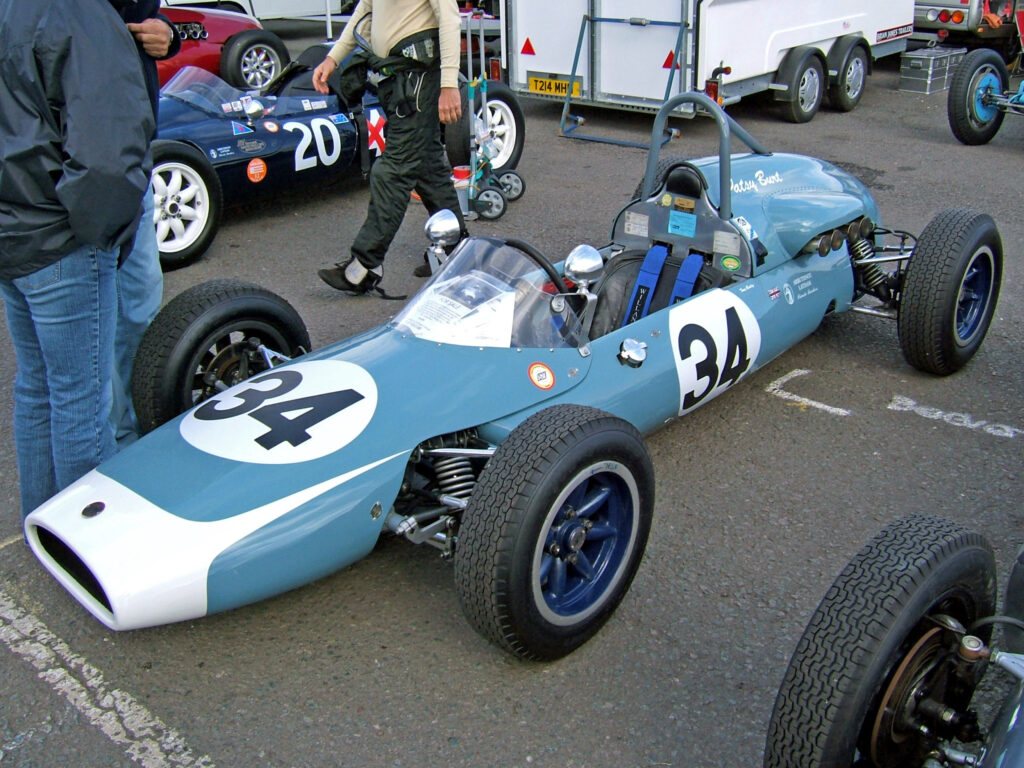
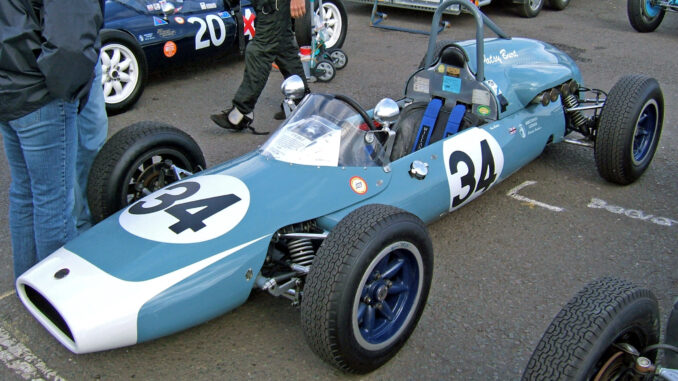
Patsy’s Cooper T43 – photo courtesy of John Chapman (Pyrope)
As time progressed, though, Patsy did become interested, and in 1953 she began competing in rallies and autotests in a Jowett Javelin. She clearly had talent because she came to the attention of Ford and Triumph, who both offered her works support.
The Javelin would give way to a Jaguar XK120 and then an Aston Martin DB2/4. However, it was the day she was competing at Goodwood circuit one day in her DB2/4 when she overheard a chap remark to his friend: “Oh, look, a woman driving. What a waste of a beautiful motorcar.” Patsy reckoned that this not only sourred her on that day but for the rest of her career.
She then added hillclimb and circuit racing to her repertoire and acquired an Aston Martin DB3S. I have had an interest in Patsy’s career for a while and I remember talking about her to the late Bill Monk, Aston Martin expert, coachbuilder and the man behind the WAM 3S.
He was particularly knowledgeable about Aston Martin racing in the fifties and remembers Patsy to be a smooth, consistent and quick driver.
Things progressed for Patsy and she stepped up to a Cooper T39 ‘Bobtail’ sports racer in 1957, the start of a long association with the Cooper marque, with her transition to single-seaters coming in 1958, in a Cooper T43.
By the time her cars were being run under the PMB Garages banner with her long time partner Ron Smith, whom she eventually married in 1983. It was a garage business in Great Bookham, Surrey with a specialisation in race preparation. Patsy’s cars were always beautifully turned out wearing her trademark powder blue with white relief colourscheme, known as ‘Burt Blue’.
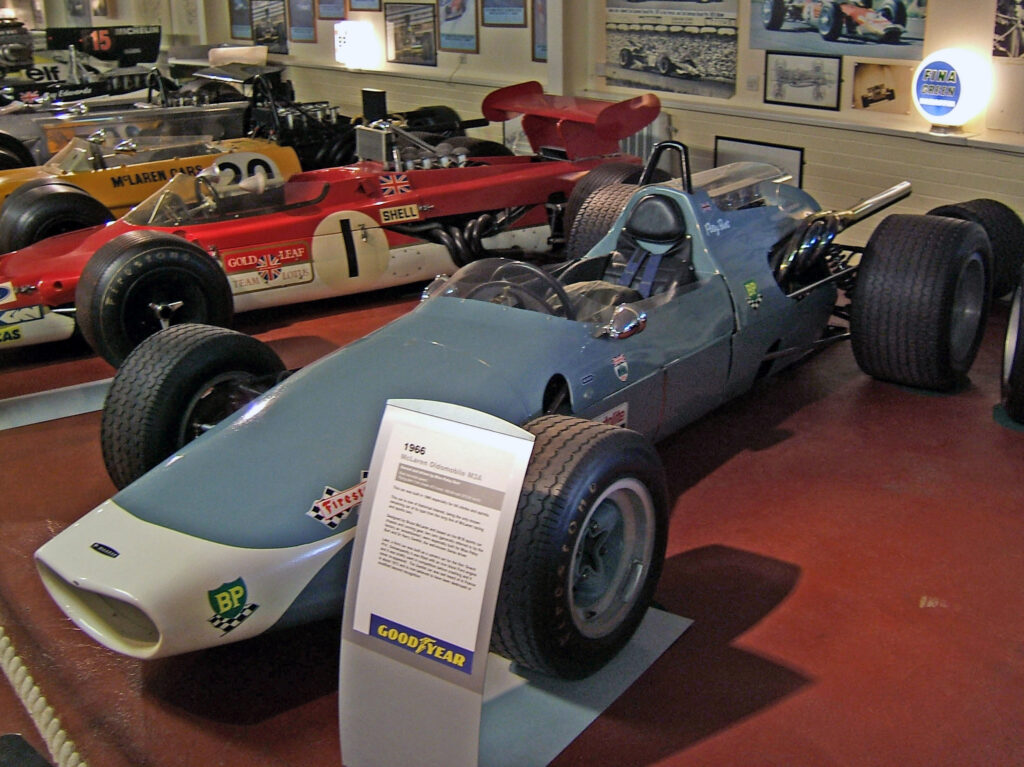
Looking very slick in Patsy’s trademark livery, here’s her McLaren M3A – photo courtesy of John Chapman (Pyrope)
Patsy was considered a very capable all rounder but by the late fifties she moved away from circuits and concentrated on sprints and hillclimbs. On a single lap against the clock she was truly formidable.
In 1961, she was equipped with a Porsche RS60 and was the first British driver, let alone female driver, to compete in the European Hill Climb Championship (hillclimb events on steroids, bascially.
The RS60 – and its brother the RS61 – are regarded as the ultimate evolutions of the 550 Spyder, with the RS61 having a slightly longer wheelbase, although they shared the same air-cooled Type 547 ‘Fuhrmann’ engine, in either 1.5-litre (166bhp) or 1.7-litre (178bhp) guises.
Patsy competed in the ‘Sports Car’ class, which in 1961, was won by Swiss Heini Walter in an RS61, although the winner of the Gran Turismo (and therefore overall champion) was none other than Porsche’s PR manager Fritz Sittig Enno Werner ‘Huschke’ von Hanstein in a Porsche 356 Carrera.
For 1962, Patsy bought a new Cooper T59 Formula Junior car, although Ron Smith and his workshop team modified the car. They fitted a Coventry Climax 2-litre FPF engine and made some other changes to it.
That car was camapigned for several years with varying degrees of success in the British hillclimb Championship. However, by the mid-fifties Ron and Patsy realised that the T59 was becoming outgunned by newer and more powerful rivals.
She decided to have a chat with her friend Bruce McLaren about buying one of his cars it wasn’t quite as straightforward as that. They had identified the McLaren M1A a Group 7 sportscar, designed by Bruce himself, which was also suited to the Can-Am series, as being the car they wanted, although Patsy wanted it to be supplied as a single-seater.
The car was given the McLaren M3A designation and was known as the ‘Whoosh-Bonk’ due to the fact that when she explained her idea to Bruce McLaren he is reported to have replied: “ … and whoosh bonk, we’ve got a single-seater” (I so want that to be true).
A striking design it also had an extended canopy-type arrangement, a low-drag nose was innovatively fitted with a timing device that was later widely adopted by others and called the ‘Burt Strut’. Her first appearance in that car, powered by a 4.4-litre Oldsmobile engine producing a conservative 360bhp and built by Traco Engineering was in 1966.
She was a popular figure on the hillclimb circuit in her powder blue McLaren ‘special’, which a huge step-up in power from her Cooper T59 and probably on a par with Formula One cars of the day.
Patsy enoyed great publicity and decent results and held the Shelsley Walsh ladies course record in 1967-68. Indeed, she set eight international and 21 national records in her M3A.
Arguably, her career highlight came in 1970 when she won the high-profile RAC National Sprint championship, also becoming the first British woman to win a national title, at the same time. Patsy felt that she couldn’t do any better and decided to retire from competition at the end of that season, going out on a real high.
That wasn’t the end of her motorsport involvement though as she and Ron continued to enthusiastically prepare cars for other drivers. Notably between 1970 and 1972 they ran Sir Nick Williamson’s McLaren M10A in the British Hillclimb Championship. The Baronet was the first man to unleash an F5000 car on the hillclimb circuit and he won the championship in 1970 and 1972 before switching to Martin Slater’s Lyncar operation and an F2-based March 712S after PMB ceased operations.
Williamson was described as a dashing character omnipresent on the hillclimb scene until his death in 2001, in the latter years always to be seen at Wiscombe Park in Devon, owned by his uncle, Major Charles Lambton. A memorable quote attributed to Sir Nick (told to me by Marcus Pye) was he was once asked what he did for a living and replied: “Not very much at all, actually.” Brilliant.
Back to Patsy and PMB, they’d previously helped run Arthur Owen’s Cooper T53 in the British Hillclimb Championship in 1962, so they were very experienced.
I remember seeing Patsy’s McLaren M3A on display at Donington Park’s Museum in Tom Wheatcroft’s beautiful collection, where it lived for many years. Other cars that Patsy Burt drove at various times included Connaught B4, MG TD, Tojeiro, Mercedes-Benz 300 SL and McLaren M12.
When all was said and done Pasty had racked up 42 outright victories, 172 class wins and 151 ladies prizes. Oh … and the obituary in the Daily Telegraph following her death on October 4, with the announcement: “Patsy retired on Lap 73 due to mechanical failure,” is a classic.