





Most TKC MAG/totalkitcar readers will be aware of an ‘overdrive’ unit, some will know exactly how they work. How many really understand what ‘Laycock de Normanville’ means?
I’ve heard several people, when asked if the overdrive on their MGB is a ‘Laycock’ answer: “No, it’s a Normanville unit!”
Time, I think to tell a little story about the UK’s most popular epicyclic overdrive unit, for those who are unaware.
Although ‘Laycock de Normanville’ sounds like he could have been one of the musketeers, it’s nothing more exotic then ‘Laycock’ referring to the manufacturers, Laycock Engineering and ‘de Normanville’ referring to the unit’s designer, Edgar de Normanville.
Actually, it’s quite a fascinating story.
Dear old Edgar was quite a guy. His correct title was: Captain Edgar Joseph de Normanville and he was born in 1882.
In WW1 he served with the Royal Engineers before becoming the motoring correspondent for the Daily Telegraph [italics] and The Chronicle [ITALICS] He later moved to the Daily Express [ITALICS] and the highly regarded motoring magazine called The Motor.[ITALICS]
He described himself as a technical jouranalist, engineer and inventor.
Edgar had designed a four-speed epicyclic transmssion for Rootes Group manufacturer, Humber and in 1948 he unveiled his definitive Laycock de Normanville [LdN] two-speed overdrive unit, which was built by Laycock Engineering in Sheffield. Incidentally, Laycock has a fascinating history, more on them shortly.
It wasn’t unique, however. There were a variety of overdrive units available made by such as Fairey and BorgWarner, however, the LdN was by far the most popular with an estimated 3.5 millions built over a forty-plus year period.
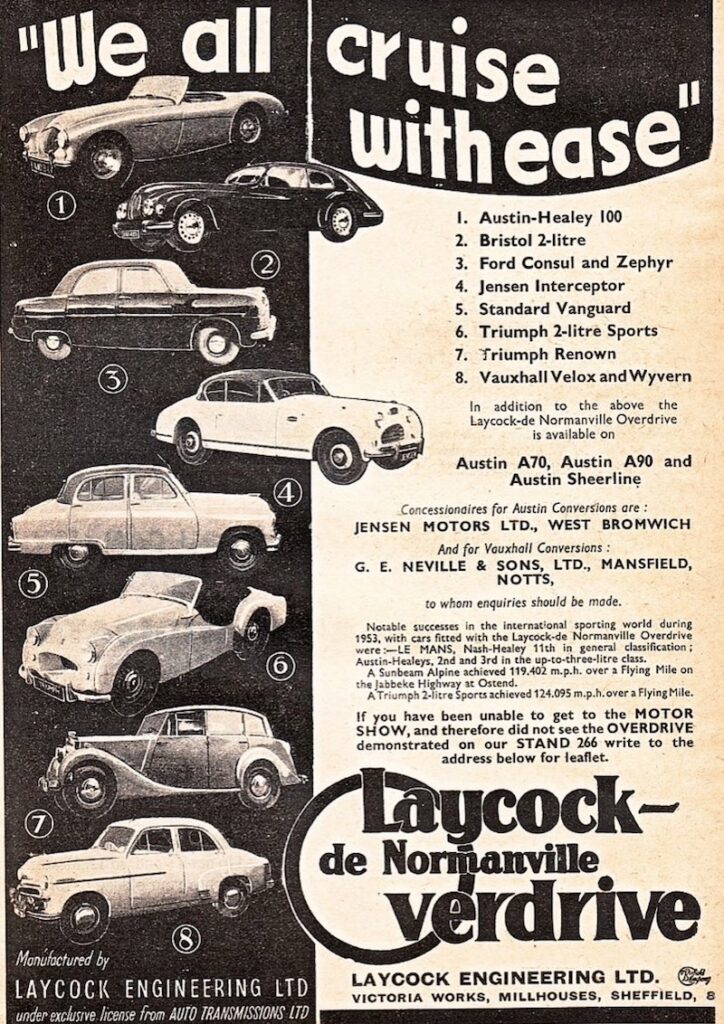
It was used by a whole raft of car manufacturers between 1950 and the end of the seventies including – Jaguar, Land Rover, Rover, Bristol, Healey, Alpine, Hillman, MG, Triumph, Volvo and US manufacturers AMC and Chevrolet all offered the unit as standard or as an option. Crikey, even Ferrari used it on the 250 GT 2+2 and Facel Vega on the Facel III, no less.
Just in case you don’t know how an LdN overdrive works here’s a gentle and basic description. The basic function of the overdrive is to change the overall reduction ratio between the engine and rear wheels. It operates in two modes, direct drive, where there is no change in reduction ratio and the overdrive ‘engaged’ mode where it provides a 22 per cent rpm increase in the output over the input revs.
This means that for a given rpm, the road speed is 22 per cent more when overdrive is engaged. Put another way, when engaged, revs are reduced by 18 per cent. The overdrive is activated via an electrical switch typically on the dashboard, steering column, or gearknob, depending on the model
When your grandad engaged his overdrive, often if it was attached to his gearknob (steady!) and he’d operate it like he was launching a torpedo on a submarine! It altered the car’s gearing to allow a tall enough ratio to enable the gearbox’s output shaft to spin faster than its input.
I remember as a kid, being fascinated by my uncle’s Healey 3000 revving its nuts off until he engaged the LdN when it seemed to quiten down yet still go faster.
There were, as far as I am aware, five variants of the Laycock de Normanville overdrive, the A Type – don’t get confused, but there were five versions of the A Type – was the first one and although also used by the likes of Jaguar and Aston Martin. It was a factory option on a host of Triumph models TR2, TR3, TR4, TR5/250 and TR6 until about 1972.
D Type – This was a more robust version and was extensively used on the MGB Mk1 between 1962-1967 on the three-synchro gearbox. It effectively gave a fifth gear for cruising.
Volvo was the most enthusiastic non-British manufacturer to use the LdN Overdrive and they offered the D Type as an option on the 120 and P1800.
LH Type – An even more rugged version offered in two main variants.
Between 1968-1974 it was an option on the MGB on the four-synchro gearbox. You’ll typically find the so-called LH ‘Black Label’ (it had a black label positioned under the solenoid!) and the LH ‘Blue Label’ (yep, it had a blue label under the solenoid!).
Compact – As the name suggests this was a smaller LdN used where space was at a premium.
J Type – The J Type LdN had stronger internals and could handle higher torque figures. It was used by Volvo between 1975-1986 on their M46 transmission, which meant the 140, Amazon and 200 Series.
Triumph also offered the J Type as an option on the Stag, 2000, 2500TC, Spitfire, Dolomite and later TR6s.
LAYCOCK ENGINEERING
Founded in 1884 by William Laycock [1842-1916] to produce parts for the railway industry, primarily for rolling stock.
When Laycock died in 1916, a chap called Davison Dalziel took the helm, although in 1919 they merged with French engineer Fernand Charron’s eponymous company based near Paris. The latter had been producing cars and also aircraft engines under contract to the British government.
A subsidiary called Charron-Laycock was formed and at the Paris Motor Show of 1921 they displayed the Type TC and Type PGM models. The cars were designed by William Bennet-Milward with Laycock producing the chassis.
Within a few years they seem to have run out of steam and by the mid-twenties they were concentrating on ‘light cars’ such as the Charronette, before Charron became Citroën dealers.
Laycock entered receivership in 1926 and it looked bleak for their 700 staff until a man called Herbert Hill led a team of investors who saved the day and installed Sheffield engineer and ship breaker, Thomas Ward to run the business. It appears, they gave it to him!
Anyway, in 1936, Ward sold it to another group of investors who set up a new holding company called Birfield Ltd, where Laycock joined another transmssion company they had also bought – Hardy Spicer, although both remained autonomous. Laycock returned to their railway work as well as building up their automotive range of products.
They began making Edgar de Normanville’s overdrive units from 1948 but they also made stuff such as diaphragm clutches, garage equipment, brake components and control valves for liquid and gas.
In 1966, the vast GKN Group purchased the Birfield businesses meaning that Laycock and Hardy Spicer came under the GKN banner. The former maintained their own identity well into the late seventies before it was ‘absorbed’.
So, the next time you see an MGB, a classic Triumph or a Volvo Amazon, give a little though to the Laycock de Normanville overdrive.