





PHOTOS TO FOLLOW
STEVE HOLE TELLS THE STORY OF PETER AGG, THE LATER YEARS OF LAMBRETTA CONCESSIONAIRES, TROJAN ENGINEERING, TROKART, TROBIKE, HEINKEL TROJAN 200, ELVA, MCLAREN, HERON SUZUKI AND EVEN VESPA… PHEW!
This is a great story and one that isn’t always told in its entirety. Plenty has been written about various (notable) elements of the Trojan business but I’ll attempt to group everything together in this one.
Trojan Cars had been founded way back in 1914 by Leslie Hounsfield, moving to Croydon in 1927. Their history has been widely documented and we’ll concentrate on their acquisition by James and Peter Agg in 1959 and what came after.
James Agg was a very successful businessman. His interests included importing French wine (he ran a very successful wine merchants), motor scooters, finance and hire purchase. He was joined by his son, Peter, a real larger than life character and an incredible entrepreneur.
The Aggs’ career path changed in 1959 when they acquired Trojan Engineering, amalgamating it with their existing Lambretta Concessionaires to form Lambretta Trojan Group, with Peter Agg in charge.
At this stage I have to flag a personal involvement here albeit a marginal one. I was a car mad young lad whose father ran a garage business in the Croydon area who also knew Peter Agg quite well. We’re talking 1966 when I first became aware of him.
I used to help my father every opportunity I had whether it be school holidays, Saturday morning or after school sometimes and he maintained a few of Agg’s cars. He had a huge collection of classics, much of it unusual, and although I was taken to have a look once, I cannot remember nearly sixty years later.
My dad looked after his road cars and I am sure that an ISO Grifo or Rivolta is nagging my memory. A big man in stature, too, I remember him seeming like a giant when I was five! I do remember usually him saying: “… and how are you today young, Stephen?”
I did love it when my mum got a job as a cleaner at Trojan, primarily in the Lambretta offices I think. It’s funny (!) but I always volunteered to go with her whenever I could, just so I could be nosy and have a poke around. It was like my own adventure playground. Even though she always told me to stay close, I’d invariably go walkabouts and look at all the scooters and the Trojan 200 ‘bubble’ cars.
I often wonder if helping my mum back then is why I don’t mind doing a bit of vacuuming!
I’ve seen it said that Agg acquired the Lambretta business when he took over Trojan Engineering. This isn’t the case. Trojan had lay dormant for about ten years before he came along. The Aggs already had Lambretta in their portfolio. They’d got involved almost by default after a bad debt saw them acquire a quantity of Lambretta scooters.
Ever the skilled operator, Peter could see a huge opportunity and in 1951 travelled to Milan to meet the bosses of Innocenti, the makers of the Lambretta. He returned as the UK’s new Lambretta Concessionaire (his deal also included sales for Gibraltar and the Isle of Man, too).
His Lambretta operation had been based in Wimbledon but it was soon moved to Trojan’s large factory in Croydon. I’m almost certain that the factory premises could have been pivotal in their decision to buy Trojan Engineering.
People have often wondered if Agg was a truly skilled operator or just plain lucky. The answer was that he was both. The old saying ‘being in the right place at the right time’ certainly applied to Peter.
LAMBRETTA, VESPA, HERON SUZUKI and 10-BOX SIDECARS
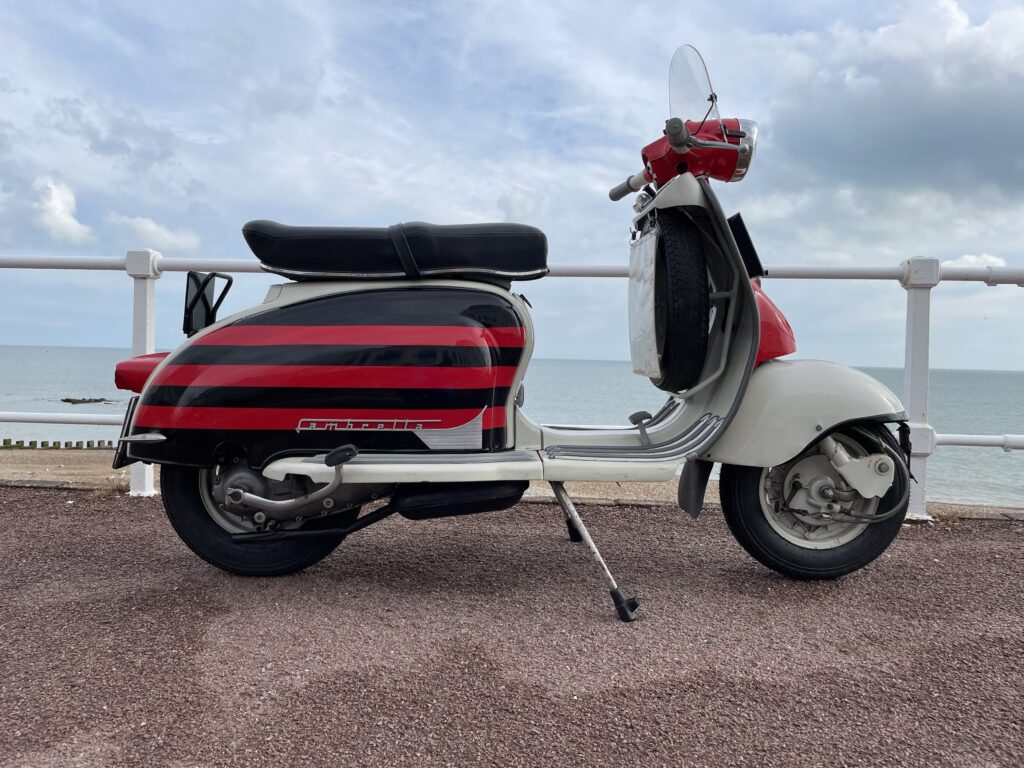
Selling Lambrettas from 1951 Agg, who although a car fanatic didn’t have much knowledge about scooters, was a quick learner. He and his father, James tried, naturally enough, to encourage motorcycle dealers to stock Lambrettas but they mostly saw it as a toy and weren’t interested.
Peter then approached some British motorcycle manufacturers to see if they would be interested in building Lambrettas under license. Again, no interest. The next plan was successful and worked beautifully.
He set up his own dealer network in the form of service centres, filled with trained staff wearing corporate Lambretta uniforms and driving vans with Lambretta lettering. There were also recovery vehicles and shelves full of spare parts and accessories. In the end there were over 1000 such service centres around the country and also a few in the Isle of Man and even Gibraltar.
The final stoke of genius was offering training for new riders. They even had dual control Lambrettas for the purpose. All this added to the feeling of being part of the fold and coincided with the setting up of several Lambretta owners clubs. Agg would actively work with them and offer support, while he’d regularly go along to functions and give out gongs and prizes. The Lambretta owners loved him.
The scooters would come into the UK in for want of a better description, kit form. Most of them would be built up in Croydon while larger service centres were allowed to put them together, too.
So successful was Lambretta Concessionaires in the UK Innocenti even offered UK exclusive engines, specs and accessories. Really they couldn’t fail and things really took off when they became Lambretta Trojan, which coincided in the industrial boom in Italy between 1958-1963.
First, they added stuff like branded weathergear, luggage carriers and other enhancements. Stuff that most owners felt that they had to have. This kind of apparel was snapped up. Lambretta Trojan could supply stuff like mirrors and additional lights so loved by mods.
Agg also persuaded Innoccenti to offer larger engines for the UK market, from 150cc to 175cc (TV175 model), although the TV150 remained available. A TV200 arrived in 1963, complete with 200cc engine, which wasn’t available in Italy until 1966.
An added bonus for Lambretta Concessionaires was the explosion of the so-called Mod Culture of course which included fashion, music even fighting with rockers at seaside resorts like Brighton. Being a mod was a way of life for many people, which included everything that went with it such as a Lambretta or their main Italian rival Vespa (imported to the UK by the Douglas Engineering company until 1972).
With the impending arrival of the Li S3 (‘Li’ for ‘Luna’ and designed by Bertone), Agg hatched a plan to help clear his stock of Li S2 models, so, with Innocenti’s permission, Trojan Engineering created the UK market Li 150 S2-based ‘Rallymaster’ model (in the UK there was quite a scene for people rallying their scooters, so Lambretta Concessioniares tapped into that).
This featured the Spanish-spec Lambretta ‘turning’ front mudguar rather than the standard fixed type. It had the long dual passenger bench seat, sport lamp, a spare wheel behind the legshields, with a dashboard featuring a rev counter, a stop watch holder and even a map reading lamp. The Rallymaster also featured a Perspex windscreen.
At £181 it was £22 more expensive than the standard Li 150 S2 although just £2 more than the more powerful TV (Turismo Veloce)175 model. Other models sold by Lambretta included the Special (125cc and 150cc), the SX (Special X in 125cc or 150cc forms), GT200, which became the Grand Prix 200 in 1969.
Lambretta Concessionaires also produced the ‘10-Box’ sidecar and sold a few of them.
In a move that ultimately backfired on him, in 1968, Peter Agg was instrumental in the deal with British Leyland that saw Innocenti gain a license to use the Mini’s A-Series engines in their domestic market cars.
When BL bough Innocenti out in 1972, they stopped making Lambrettas and sold the whole project to an Indian company. This spelt the end of UK Lambrettas for a time, although Agg imported them from the Spanish concessioniare for a while, turning his attention to Vespa, When Douglas Engineering stopped activies.
He’d kept the workforce at Trojan Engineering in place so it was easy enough for them to switch allegiances to a different brand albeit on a smaller scale. They kept the Vespa business for several years but it was never as successful as the Lambretta business.
As a shrewd businessman, Agg always got wind of stuff that was happening either officially or a via his network of contacts. He could see the situation with Lambretta changing drastically and did a deal with Suzuki in Japan to become the UK’s official importer in 1972. He also used the existing Lambretta infrastructure that he already had in place.
They also formed the Heron Suzuki motorcycle team too and I believe it was Peter Agg who gave a young Barry Sheene his first real race opportunity.
TROKART
The Trokart came along shortly after the Aggs had acquired Trojan Engineering with the first ones appearing in late 1959. The US had scene an explosion in karting, with a similar, if smaller, boom following in the UK.
The Clinton Corp, an American manufacturer of two-stroke engines typically used in lawnmower milking machines, stationary engines, pumps and chainsaws had reportedly sold 75,000 of their 90cc Panther engine (they also did a 75cc version). It was perfect for karting. Coincidentally, Peter Agg’s Lambretta Trojan Group owned Clinton Corp.
When Agg noticed that the RAC had devised a race series and proper regulations for karts he decided to introduce the Trokart. It was obvious for him to use the Clinton Panther 90cc engine producing 2.5bhp. He sold them in kit form at £25. Thousands were sold.
TROBIKE
A natural companion to the Trokart was the quirky-looking Trobike, which was launched in 1960. It featured the same A490 90cc engine used in the Trokart. A very basic and rudimentary machine maybe but the Trobike proved very popular. It was used by lots of teenagers to learn to ride on.
The Trobike had no suspension but it could 32mph flat out. Two versions were available – the Road (with light, front brake and a numberplate) or a Garden model (not for road use). Both were available in kit form (from £39) or fully built (from £49).
The Trojan Trobike had the market for such machines to itself until the late sixties when the better Aleywood Chimp stole its thunder.
Lambretta Trojan only sold around 600 Trobikes and they sold it to concentrate on their new contract to build Heinkel Kabine ‘bubblecars’ from November 1961. All hands on deck for that one.
As a result in 1962 the Trobike project was sold to West Sussex-based Howard Park (brother of UK hot rod pioneer, Richard Park) who sold it as the Sussex Miniscooter.
HEINKELS UNDER LICENSE
The German Heinkel Kabine ‘bubblecar’ was produced between 1960-65. A company called Dundalk Engineering had the license to built them in the UK. Models included Kabine 150, 153 and 154.
Heinkel became upset at the build quality of the Dundalk-built cars and withdrew their license. In November 1961, Trojan Engineering took over. They renamed it the Trojan 200, powered by a 198cc engine, improved quality and built about 7000 of them until 1965.
ELVA CARS
When Elva Cars entered voluntary liquidation the roadcar side of the business was taken over by Trojan Engineering in 1961, with Frank setting up Elva (1961) Ltd to concentrate on his racing models.
He was retained as technical director and competition manager by Trojan, however. Incidentally, the other Trojan board members at the time were: Peter Agg, chairman; John Bennett (general manager), Keith Marsden (designer), Bill Meece (assistant GM) and Ray Veness (workshop manager).
Trojan Engineering carried on producing Elva Courier Mk2s in East Sussex and also at Trojan Works in Croydon. About 350 of them were built.
The first all-Trojan Elva was the Courier MkIII in 1962, with production now solely in Croydon. It was based on Triumph suspension with power from the MGA 1622cc or Ford Pre-Crossflow engines. Early in production, Elva offered a notchback coupe complete with hardtop, but just ten of these were produced. Around 100 were built.
Trojan developed the MkIII into a 2+2 fastback selling it alongside that car and called it the MkIV although this had been superseded within a short time by the T-Type featuring Elva’s new Tru-Trak independent suspension set-up.
Trojan continued Elvas until 1965, when they took on McLaren’s non-single-seater build work. Bruce McLaren Racing Cars Ltd was based in Colnbrook. McLaren and Peter Agg got on very well and his company’s motorsport division Trojan Racing was given the contract to build customer (non-works) cars starting with the M1, although they soon were given all non-F1 models to build including the other Group 7 Can-Am cars such as M6 and M8 and all variants of them. This included the roadgoing M6 GT.
Their McLaren work ceased with the tragic death of Bruce McLaren while testing an M8D at Goodwood on June 2, 1970. I have seen it written that they produced around 200 vehicles for McLaren.
TROJAN TAURANAC RACING
After McLaren Peter Agg collaborated with ex-Brabham co-owner and skilled designer, Ron Tauranac and they build several single-seaters T101, T102, T103 and T104 for the likes of F5000 with Jody Scheckter won the F5000 SCCA championship in 1973. In 1974 they enttered eight Formula One Grands Prix with Tim Schenken driving.
Also, in September 1974, David Purley won the Brighton Speed Trials in a Trojan T101.
Post Trojan Peter Agg retired and moved to Reigate, Surrey where he passed away in March 2012