










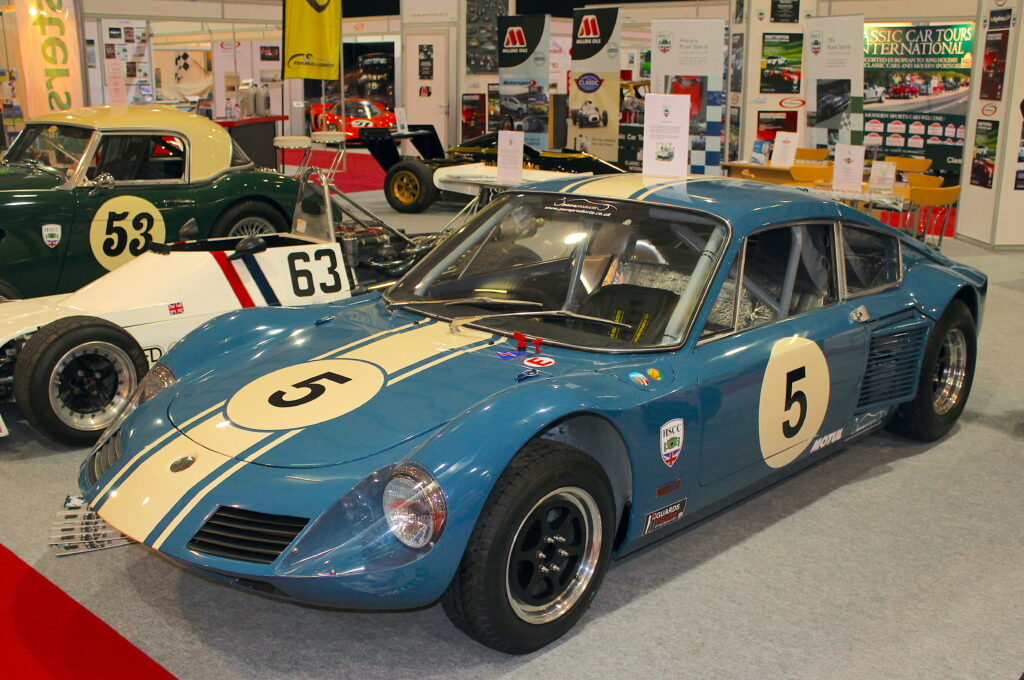
STEVE HOLE tells the story of the Elva GT160 Coupé of 1964. Crikey, that makes the design 62 years old. Amazing.
I think most specialist car enthusaists think of Elva as making roadcars available in kit form. The Courier in various guises. Nothing could be farther from the truth really. Elva founder Frank Nichols was always enthusiastic about motorsport and his cars enjoyed much success in the days of Formula Junior before progressing through various championships and other formulae.
In those early days he would frequently cross swords with Lotus founder Colin Chapman and a big rivalry developed between the young engineers and team bosses. He famously told Chapman to ‘get stuffed’ after one altercation.
In many ways, Nichols and the Elva marque are still very underrated. The similarities, albeit on a smaller scale, with Lotus are marked. The quality staff and engineers, the spin-off companies that were founded by ex-employees that grew to become well-regarded in their own right. Add to that the real character that was Frank Nichols.
At Elva there were the likes of engineer Malcolm ‘Mac’ Witts (although he departed in 1956), designer Keith Marsden and others like Bill Meace, Arthur Rothon, Lenny Marchant, Ted Cox, Bob Curl, Ted Martin (engines) and John Bennett among them. Tony Barnard who later founded AJ Barnard Engineering in Bodiam, East Sussex.
Bob Curl (another proper gent) once told me a great Nichols story. In fact, he has told me a few but only this one can really be repeated! Bob was busy working away on a new model that was due for launch the Racing Car Show in early January (I’m not sure which year). He’d been pulling double shifts in December frantically trying to get it done.
He worked on Christmas morning and then quite reasonably thought he’d pop home for his Christmas dinner. I think he returned afterwards. Anyway, when Frank came on Boxing Day morning he discovered what Bob had done and sacked him on the spot! Despite that Bob has always held Frank in very high regard.
Bob’s later career would take him to Lotus (he’s told me some great Chapman stories, too!) and then to a freelance design career which included the Nomad (Mk1 to 3) sports-racer for Mark Konig.
Back to Elva – It’s important to note the existence of a motorsport team called Equipe Elva London, which wasn’t as you might have thought an official Elva works team. This was a separate operation that raced Elvas run by Stephen Miniprio and Robin Benson. In his excellent book ‘Elva – The People, The Cars, the History’ János Wimpffen quotes Minoprio thus: “When we won Frank was happy to treat us a works team but when we ordered parts we were just a customer.”
Another good friend of mine, Ernie Unger, was technical director at Equipe Elva London and he speaks very highly of Frank and has also told me some great stories. Ernie says that his racing pedigree – he’d formerly worked for Frank’s nemesis Colin Chapman – gained him Nichols’ respect and he saus that some of his suggestions were adopted by Frank for his own racecars.
Ernie later designed the Unipower GT, of course as well as running Gordon Spice’s racing team amongst other endeavours including Rootes Group and Ian Walker Racing.
When Elva Engineering went bankrupt Peter Agg’s Trojan-Group acquired the rights to the Courier, now part of Lambretta-Trojan division, while Frank set up again as Elva Cars (1961) Ltd concentrating on racecars, although he acted as a consultant to Trojan on all matters Courier.
You can read more about Peter Agg’s Trojan Group elsewhere on this website under the Classic Kit Cars & Specials banner. Just search ‘Peter Agg/Trojan’.
In 1964, with Frank looking to new adventures Trojan took over the rest of his business by acquiring the race orientated Elva Cars (1961) Ltd. Frank was one was of six directors, which included American importer and champion Stateside of all things Elva, Carl Haas, Nichols’ old mate William Murphy and Peter Agg as MD.
Many Elva racecar people, hitherto remaining with Frank in Rye moved to Trojan’s Croydon HQ including factory manager, John Bennett, sales manager Geoff McMullen and general manager Bill Meace. One key figure, Keith Marsden, wasn’t happy with the Trojan had run the Elva roadcar business and decided to leave.
The future days of Elva under Trojan is a whole new story that I need to defer to real marque experts like Janos Wimpffen and Roger Dunbar. In particular, I recommend you visit Roger’s excellent Elva-related website www.elva-archive.com, where you can find every detail you could wish for on the marque.
Suffice to say that Trojan is often criticised for not promoting or getting behind Elva enough, which I believe is a mite unfair given that Elva was just part of the Trojan Group as a whole (this also included the Heinkel ‘bubble car’ the trojan 200) and the fact Peter Agg was sceptical of motorsport as he said it was ‘too expensive’. However, Carl Haas was said to have been frustrated with them. He had a ready made market in the USA but couldn’t get the cars quick enough.
Elva did lead Trojan to their association with Bruce McLaren. After the final standalone Elva model the MkVIII, the racing cars were built under the McLaren-Elva banner.
Without further ado let’s turn attention to the Elva GT160, which is the reason, after all, that you came here.
The year 1964 was seen by Frank Nichols and Peter Agg as THE year for the Elva marque. They wanted a car that might attract potential Lotus Elan and Jaguar E-type buyers with a car that could be raced but could equally serve as a GT roadcar.
Under the skin, it used a slightly modified version of the successful mid-engined Elva Mk7 and Mk7S with a multi-tubular spaceframe and independent suspension all-round.
They wanted a more sophisticated looking vehicle. They were confident that the underpinnings were of the highest order. In the Mk7 they had a formidable machine. It was said back in the day that only a very well driven Brabham BT8 was capable of beating an Elva Mk7, while is fiercest rival was always reagrded as the Lotus 23.
Frank was all for engaging the services of Ogle Design (post-David Ogle) as he new Essex Wire chariman and Ogle chairman John Ogier and his friend and fellow Ogle director Sir John Whitmore very well (the latter had raced Elvas as a young racer) so felt it was the right thing to do.
He was over-ruled by Peter Agg, who had connections with Italian Carrozzerie, was UK concessioniare for Lambretta scooters and was UK importer for ISO (bubble cars ans ‘proper’ cars like the Grifo), so he decided to go to Carrozzeria Fissore of Turin and their English born designer Trevor Fiore.
The GT160 (‘160’ indicating the expected top speed’ was the result. Fiore came up with the beautiful fastback shape and cleverly managed to keep the Elva family resemblances, such as retaining the distinctive twin air vents in the nose that the mid-engined Elva Mk6 and Mk7 had.
Standing just 40in high – or ‘low’ depending on how you view these things – the car weighed in at just under 600kg.
The engine is an interesting story. When Frank had been looking around for possible new engine suppliers, Porsche and BMW would come onboard. He approached the latter and had meetings with the Bavarian manufacturer’s engine boss, Alex von Falkenhausen. Initial resistance from BMW (the 1498cc unit in question was expensive to produce) soon gave way to a done deal after Frank had involved his engine guru Ted Martin .
People often refer to Elva (Trojan) using a BMW 2-litre engine. This is true but how they got there is a little more complicated. The BMW 1498cc that Elva was interested in had 80bhp. Further work saw it increased to 1600 (83bhp) before Nerus Engineering’s Frank Webb got involved.
First came the Nerus BMW 1800 TiSA which had 110bhp and then the unit that the GT160 is forever associated with the 1981cc 185bhp (it revved to 7200rpm) version, with dry sump and larger valves. With the latter engine, the Elva corruption of the French ‘Elle Va’ certainly applied. The GT160 certainly did ‘go’.
Webb was a cylinder head colossus and the BMW ‘head was fitted with a race-spec flywheel, forged pistons, heavy duty conrods and a high performance clutch.
Customers could also opt for the less highly-strung 1800 TiSA unit if they preferred but who wouldn’t want the 2-litre boot-boy?
Nerus Engineering was one of the many sixties companies based around the Bexhill/Hastings area, fuelled no doubt by the proximity and influence of Weslake Engineering and Elva Cars. Names like AJ Barnard Engineering, Rytune, Marchant & Cox, Checkpoint, Mogram Engineering and Nerus’s parent company Rother Iron Works, were all kept busy.
The Nerus name was actually the surname of Rother Iron Works’ boss. Mr Suren spelt backwards! When they engaged the services of former Lagonda, HWM, Rytune and Weslake (he’d been Harry Weslake’s right-hand man), cylinder head expert, Frank Webb, their fortunes rose rapidly. You’ll find a bio of Nerus Engineering on the totalkitcar website (just search ‘Nerus’ when you get there).
BMW was clearly so impressed they appointed Nerus as an official engine builder, and they were allowed pretty much free rein on the 2-litre engines used by Elva, and I think also on Vosper’s powerboats.
The car was launched at the Turin Motor Show of 1964 and was incredibly well-received. Its future looked very rosy. Except it wasn’t. Once Elva’s Frank Nichols had tallied up the costs of development, they had spiralled to twice that of their set budget, the cars being built in Italy and then shipped to the UK was a nightmare in terms of costs and then the final straw was that the FIA changed ground clearance rules which meant that to redevelop the GT160 to comply would be prohibitive so they cancelled the project with immediate effect. A shame as the GT160 deserved a much better fate.
That wasn’t quite the end of the story. Trojan’s Elva Courier agent and later licensed builder and top stuntman/driver Tony Sheppard of Tony Sheppard Customised bought the three prototypes (it was Tony who completed the second one and fitted a Buick/Rover V8) and intended to do what Trojan didn’t do and productionise the car. He was going to revise the name to 160XS. Ultimately nothing came of that idea, unfortunately.
As the GT160 was intended for series production, customer cars would have featured GRP bodies rather than the aluminium Williams & Pritchard fabricated ones.