






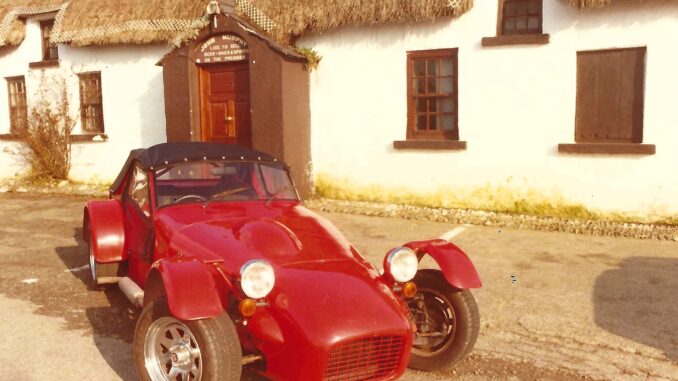
STEVE HOLE tells the story of another superb car from the late legend that was Frank Costin called the TMC-COSTIN.
The late Frank Costin was an automotive legend of design and aerodynamics. However, by the late eighties he’d become disillusioned with the automotive industry and moved to County Cork in Ireland.
While there he became involved in several projects including the design and build of his own house on the coast, lecturing in design and aerodynamics at various colleges while he was very popular with the Irish government who really liked his ideas on training young engineers.

So much so, they suggested an initiative that would see them sponsor a twenty week course for ten university students where they would spend six weeks with Frank, then ten weeks on hands on secondment at an engineering company before finishing with four weeks at Frank’s.
Another little-known Frank project while he was in Ireland was a light aircraft, a timber biplane that he was intending to offer in kit form. Unfortunately, promised funding for the project never materialised.
However, Costin was also working for Timoney Research & Technology in Gibbstown near Navan, County Meath. The company was a leading company involved in heavy and specialised vehicles.
They were involved in design, prototyping and manufacturing a range of vehicles involved in defence, fire and construction. Frank was design chief for their military trucks and airport fire tenders division.
Also employed at the company at the time was draughtsman Peter Thompson along with two of his five brothers, Val (chief financial officer) and Sean (a design technician).
[crosshead] CARS NEVER FAR AWAY
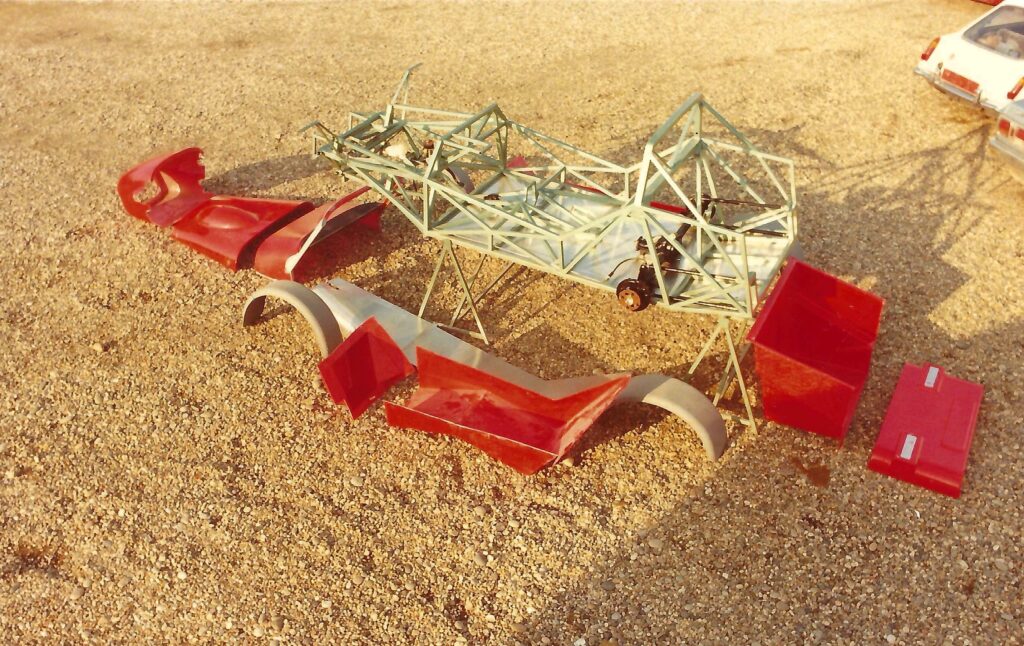
Although Frank had never designed a Lotus Seven-inspired sportscar, he was a fan. Before he’d moved to Ireland he designed a project that he called Rushabout. He had already been working on evolving his beloved timber monocoque into a steel spaceframe, first on the Costin Amigo. He also wanted it to look like a Lotus Seven, while pushing the design slightly.
An American chap, an acquaintance of Frank’s, had expressed an interest in importing the car to the USA, although financing fell through and nothing came of the idea. It’s amazing really. There were so many very well-known projects on Frank’s CV starting with the Lotus Mk8 but there were others that deserved equal acknowledgement and success but filed for whatever reason.

Undeterred, but possibly one of the reasons he decided to move to Ireland, he kept the Rushabout design idea in his briefcase. At some time, he discussed the idea with the Thompsons who expressed an interest in the car.
This was no idle talk as together they discussed the idea further which led to the setting up of Thompson Manufacturing Company in County Wexford with the Thompsons led by Peter loving the idea of building their own sportscar.
They set Frank up in one of their barns (they were a farming family and had plenty of out-buildings) where he would develop and build a prototype, which was now called the TMC-Costin. From there he would develop all the jigs and moulds ready for series production.
They agreed that he would receive a fee for deign and development and royalty payment of 10 per cent for each sale.
The company (with another Thompson brother, Anthony onboard) received a grant from the Irish government’s Industrial Development Authority as part of their Small Industries Scheme, to build a 4000sq/ft factory in Castlebridge, a suburb of Wexford town in July 1983. The grant also enabled them to employ eight staff. By this stage the Thompsons enthusiasm was palpable.
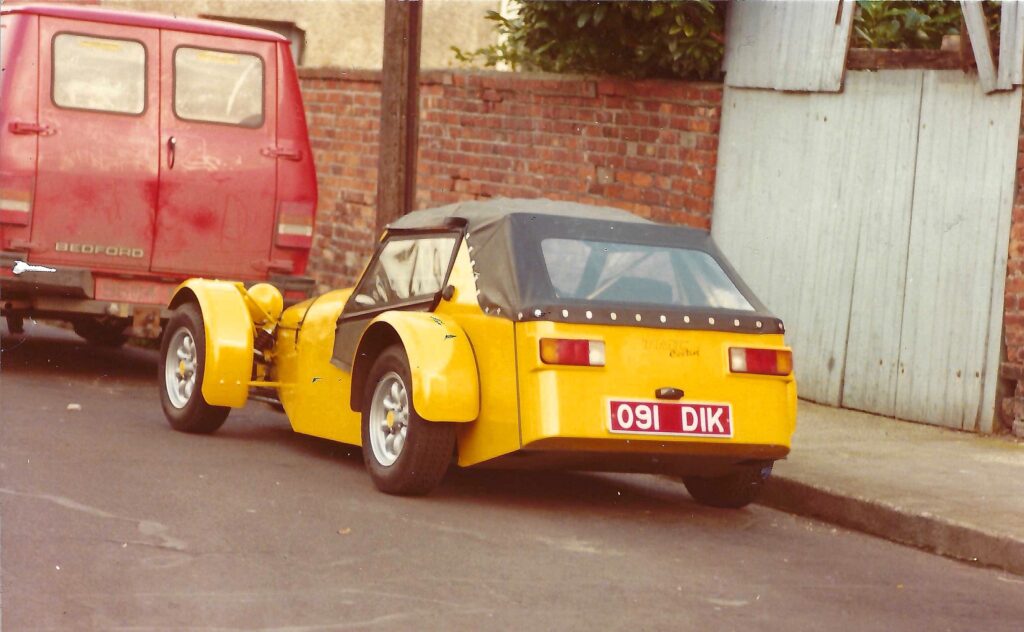
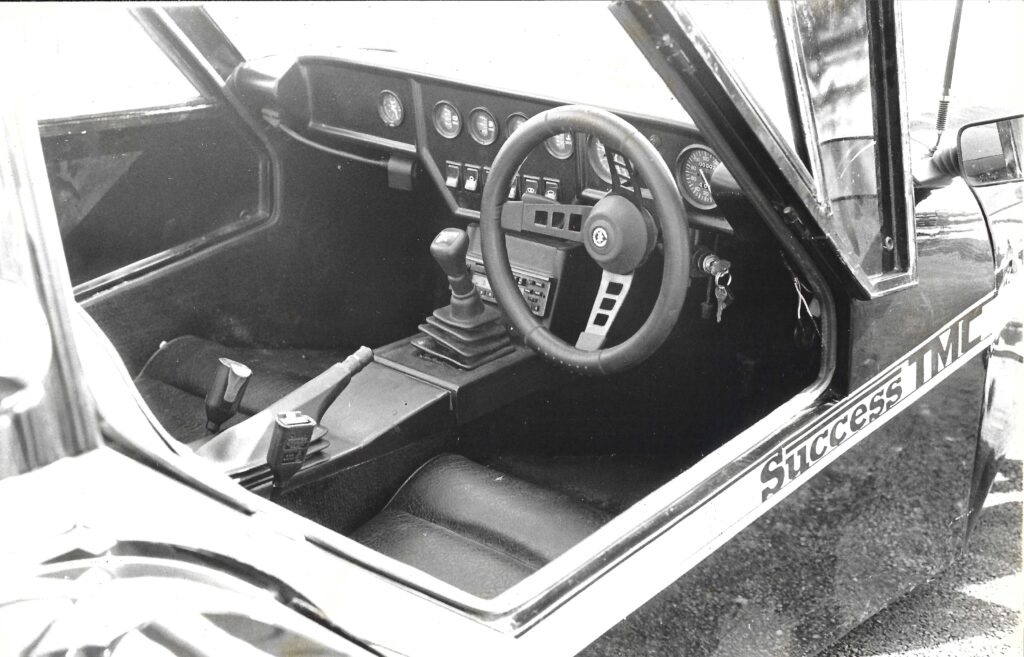
The TMC-Costin was underpinned by a very rigid spaceframe chassis and Frank had incorporated a large boot for such a car. This was deliberate because he wanted it to be a proper touring car and be able to carry full sized luggage rather than squashy holdalls.
Pilkington Glass produced a bespoke windscreen for the car while Frank wanted a targa-style roof/hood system. The ‘doorlets’ opening up and forward. Given his race background, Frank (in his heart he was still an ‘aircraft man’ regardless of his automotive success) wanted a roadcar that would be at home on track.
Therefore he wanted the car to have lots of adjustment but crucially be built using affordable parts. Although there wasn’t a donor vehicle as such it did use a lot of Chevette components such as 1256cc engine, gearbox (if using the Vauxhall engine), steering and cooling system. The body was made from aluminium sheets with GRP used for wings and nosecone.
The prototype used the Vauxhall Chevette engine, which although producing just 52bhp, was still enough to propel the 648kg TMC Costin to 90mph.
As ever, Frank’s real area of interest was under the skin. He was always more concerned with how a car handled rather than its looks and the TMC Costin didn’t disappoint as the suspension set up was pretty remarkable.
There were three distinct parts to the chassis, front, rear and centre section, while front suspension was via double unequal length wishbones with Koni dampers and full adjustment for ride height and rod end bearings. Rose-joints allowed for caster and camber adjustment. There was also an anti-roll bar at the front, too.
If the front end was trick the rear was ingenious. Expensive but ingenious. Although it employed a ‘live’ rear axle from a Chevette, Frank located it via four trailing arms and a Panhard rod. He loved that set-up because he said it promoted progressive understeer rather than potentially disastrous oversteer.
Like the front, the rear end featured Koni dampers, but these were bespoke to the car and frighteningly expensive but Frank liked them because they were self-levelling under load. The brakes were discs at the front end with Chevette drums at the rear.
Costin reckoned that there was potential for the TMC-Costin as a racecar and the Thompsons agreed and tasked Frank with building one. Frank drafted in two young engineers who had worked with him for several years (since Costin Drake Technology in fact) – brothers Stephen and Paul Crabb (the latter had revised the Triple C Challenger chassis to accept Jaguar components – and the racer had a hardtop and full rollcage as well as one of George Robinson’s Vegantune VTA twin-cam engine, which produced 160bhp.
The official launch for the TMC-Costin came in November 1983 at Mondello Park in Naas, County Kildare. Interested parties, dignitaries and journalists from Ireland and the UK enthusiastically making the trip.
The cars were incredibly well-received and nice things were written in the motoring press. However, they weren’t ready to start supplying cars mainly because they hadn’t settled on engine specifications – and when they did decide there were arguably too many to choose from, which just caused confusion.
The Thompsons had issues with pricing, too but more on that shortly.
Three roadgoing variants were available in kit or fully built forms. Customers could choose from GTA, GTB and GTC versions, while engine choices were Chevette, Ford Crossflow or Ford CVH with power ranging from 52bhp to 160bhp (interestingly, although Frank built the chassis to be able to cope with 300bhp, subsequent structure testing in America in 1988 showed that it could actually handle up to 600bhp!).
Two versions of the racer were on the pricelist – the RS, with power coming from Ford Crossflow 1700cc with four-speed gearbox and fabric ‘doors’ instead of solid ones. Then came the RSR, which had a Ford Escort XR3i-spec CVH engine with twin Weber 40 DCOE carburettor.
Now, back to pricing. Oh dear. Kits were initially priced at £2000 for a GTA with Chevette power, with full builds from £6500. Amazing value even in 1984.
I’m not sure if they had realised they had made a mistake or what but within weeks the prices had risen to £6000 for kits and from £13,000 for turnkeys (plus VAT and 23 per cent duty for Irish customers! A huge, but realistic, hike.
There was talk that Thompson Manufacturing Company wanted to appeal to young Irish-based customers (there was plenty of publicity in Ireland for the project pre-launch) and when they didn’t materialise prices had to rise accordingly.
Five cars were sold to a potential agent in Canada, who talked about fifty cars a year, but didn’t come to anything, while the majority of the kits and cars sold headed for England.
The ‘works’ racer, raced by very handy Irish driver called john Kearney was doing well and proving the car’s credentials every time he raced it.
Ultimately, I think that as a car for the Irish domestic market, which was the aim, the hefty duty added on top of VAT made it an expensive proposition. Just before they ceased trading in 1987 Peter Thompson was casting around for possible alternative manufacturing sites, with Wales looking like a strong possibility. Sadly, it didn’t happen.
Although that was the end of the TMC-Costin as we knew it, that wasn’t the complete end for the car, or rather part of the car.
Well-known American businessman and entrepreneur (the late) Don Panoz set up a company called Élan Corporation in Ireland in 1969, which was hugely successful becoming the first Irish company to be listed on the US stock market.
There is some conjecture on how his son Dan became involved with Thompson Manufacturing Company. Some say that Panoz junior did work there from 1986, while others claim that he went for a job interview just before they closed down in 1987.
Regardless, with funding from his father Don, he formed Panoz Motorsports and one of his first acquisitions was buying the TMC-Costin project from the Thompsons, with enough components to build two cars while also hiring two ex-TMC employees, Sean Thompson and technician Mick Murphy.
Panoz Motorsports officially launched in 1989 in the US and Frank Costin’s car formed the basis – they used his chassis and suspension, basically – for the Panoz Roadster.
I recommend Googling Panoz Motorsports, a company still run by Dan, with a huge reach in motorsport. They still build and race their own cars around the world while also build for customers. Panoz senior died in 2018. I imagine that his initial scepticism about becoming involved in motorsport was long gone such is the way the company grew and flourished. At one time they owned several American circuits such as Road Atlanta, Sebring International and Mosport Park in Canada, but these and the Panoz Racing School were sold in 2013.
As far as Frank was concerned he moved back to the UK and I think he remained pragmatic about the TMC-Costin, which was another near miss that should have done better. Sales? You might see claims of 26 sold but I am 99.99 per cent sure that isn’t true with the correct figure being nearer 39.
Frank had one more design up his sleeve, the Costin Roadster, yet another near miss, although with its MGF base, was a brilliant car. The great thing is though, Frank Costin’s legacy will always live on.